From time to time, I come across Tai Chi that feels lifeless, lacking a clear center, with an unfocused awareness.
The practitioner appears relaxed, with loosened muscles and slow, smooth movements. Visually, it looks refined and even beautiful.
Yet, something feels off.
Why?
Because there is no sense of a “flow” — no feeling that energy travels through the body and extends outward.
In authentic Tai Chi, energy originates from the dantian, flows to the hands, and continues outward into space, even while the body remains relaxed. At the same time, energy also travels from the dantian down to the legs, grounding into the earth.
When this internal mechanism is absent, the movement may be quiet, but it lacks vitality.
At an extreme, it can look as if something lifeless is merely moving.
The qi does not expand outward but remains trapped inside.
The awareness, too, stays internal, rather than extending beyond the body.
There is no sense of connection with space, no feeling of unity, and therefore no real interaction with the outside.
This tendency can be seen not only in beginners, but sometimes even in instructors.
What is commonly missing in such Tai Chi is the principle of “distinguishing between Xu (empty) and Shi (full).”
Although this concept is widely known, in most cases it remains only an intellectual understanding and is not embodied physically.
In Tai Chi movement, it is essential to clearly differentiate between Xu and Shi.
In my teaching, I repeatedly emphasize: “Separate Xu and Shi clearly.”
From a martial perspective, the moment of issuing force is Shi (full), and all other moments are Xu (empty).
If this distinction is unclear, the technique will not be effective.
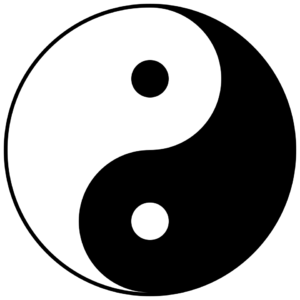
Just as the Taiji symbol clearly separates black and white, movement only gains meaning when yin and yang are distinctly divided.
If everything remains vague and “gray,” it cannot be called Tai Chi.
It is often explained that the leg bearing weight is Shi, and the other leg is Xu.
However, this understanding alone is insufficient.
After all, even ordinary walking involves shifting body weight.
That alone does not constitute the true Xu–Shi distinction of Tai Chi.
The key is to understand Xu and Shi as directions of energy flow.
In Tai Chi, there are essentially two directions of energy:
one that is released outward from the dantian,
and one that returns from the extremities back to the dantian.
The former can be understood as Shi, and the latter as Xu.
It is crucial that these two are clearly distinguished and continuously transforming into one another.
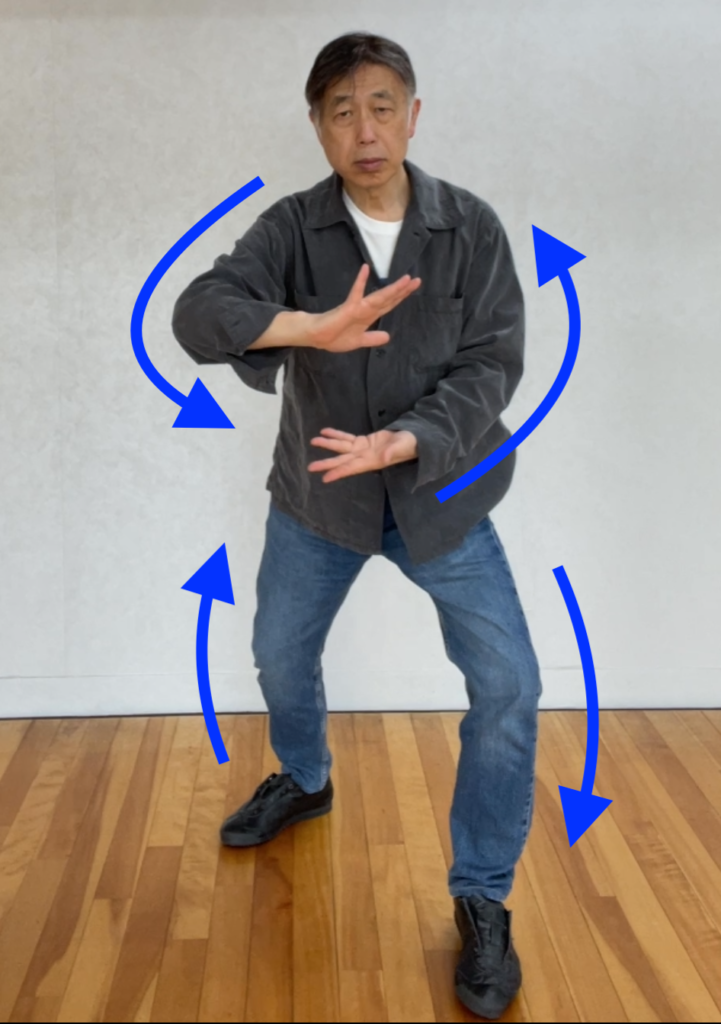
In my basic class, I use “Cloud Hands” (Yun Shou) to teach the transformation between Xu and Shi.
For example, from a horse stance, when stepping into the ground with the right foot, the right side becomes Shi.
At the same time, the left side becomes light and turns into Xu. The position of the dantian and the central axis remain unchanged.
As the hand movements are coordinated, Xu and Shi alternate from side to side.
When the right foot transmits force into the ground, the right hand simultaneously releases energy outward into space.
Only when this connection between upper and lower, inner and outer is present does “Cloud Hands” truly become functional.
In some cases, the Xu–Shi relationship between the hands and feet may be reversed left and right.
<refer to the photo below>
Being able to clearly sense and differentiate these changes is essential.